Wednesday, July 7, 2021

Independence Rock

Because shipping seems to be a little slower now due to the recovering economy, tracking info showed the windshield stalled in Denver for an extra day.  That gave us time while in Rawlins to make a day trip out to Independence Rock.  Located on Wyoming Highway 220, this landmark was the midway point on the Oregon Trail, the Mormon Trail, The Overland Express Trail and the California Trail.  We enjoyed a half day here exploring Martin's Cove, the Devil's Gate and Independence Rock all located within about 3 miles.

 The first stop on Wyoming Highway 220 about 2 miles south of  Independence Rock is Martin's Cove.  To learn more about Martin's Cove and its history, click HERE.  This area was the campsite location used by the Martin Handcart Company after the rescue of 2 of their companies in 1856.  Unfortunately because of several factors: bad weather, lack of food, illness, exhaustion and the decision to leave too late in the year, it all lead to the loss of between 135 and 150 emigrant lives here.  This was the greatest loss of life from any single event during the entire Westward migration period.

Entrance way to Martin's Cove

That crack in the rock is called the Devil's Gate.  Eroded by the waters of the Sweetwater River, this crack was a notable landmark used by all travelers on the Trails.  The Devil's Gate and Martin's Cove are all in one area.


Now a working ranch owned the Church of Latter Day Saints, Martin's Cove is also a museum and Interpretive Center.  The first homesteaders were the Sun Family.  Settling here in 1872, Tom Sun Sr. built his cabin near the Devil's Gate and the Sweetwater River Valley.  A small section of the building shown below is part of his original cabin.  It has been restored and now houses a museum of their family artifacts, info about the Martin Handcart Company and the sad fate of the two companies of emigrants that camped here.


Inside the museum was this beautiful stone fireplace consisting of different types of rock.  Tom Sun's wife loved to collect rocks, even receiving some as gifts from travelers as they passed by their homestead.  She used her rock collection to create this unusual fireplace.
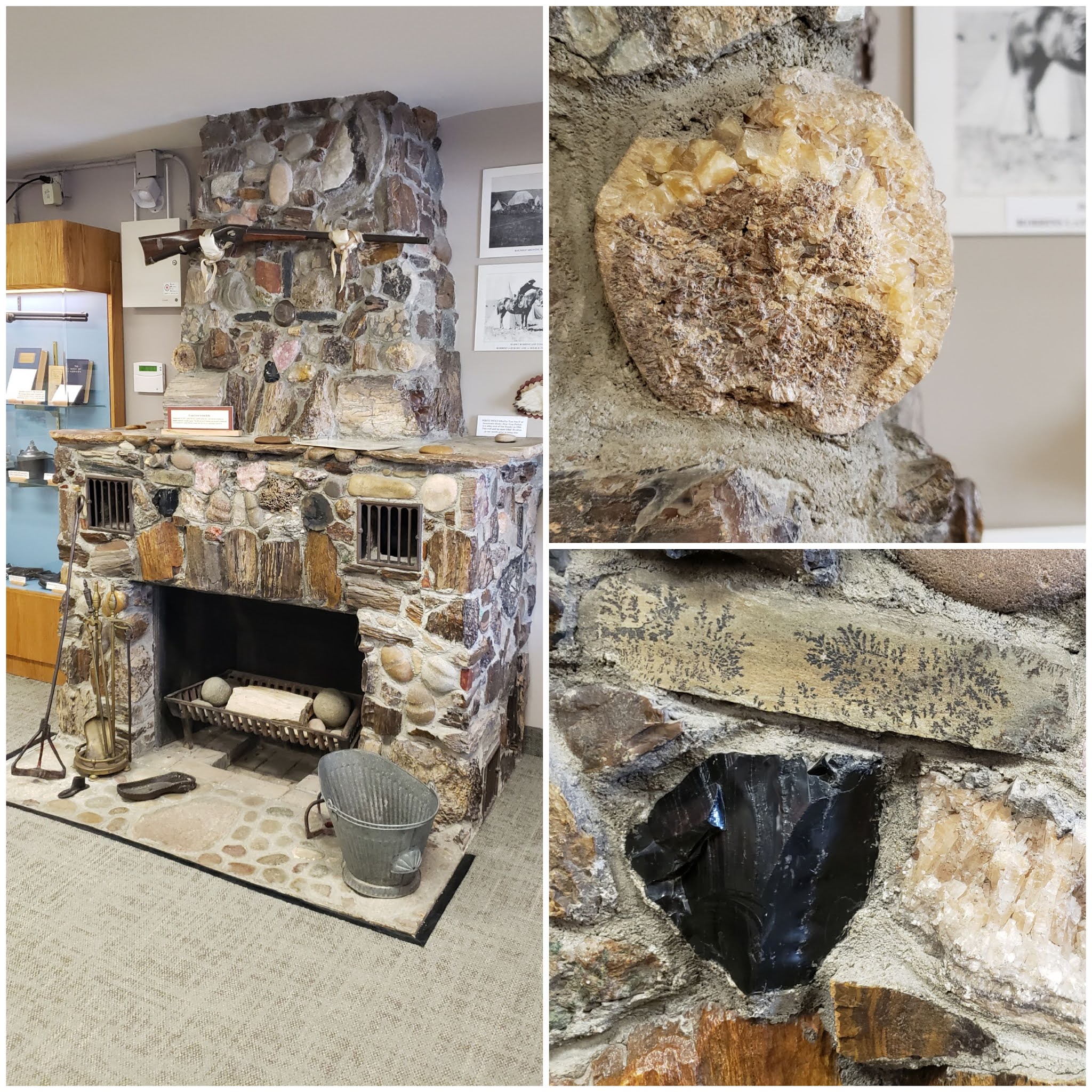
Top right, that's a petrified Wooly Mammoth tusk, Lower right, obsidian rock.

This Evans Lever Action Rifle, made in 1873, was a gift to Tom Sun Sr. from Buffalo Bill.  Their early friendship was instrumental in developing Buffalo Bill's sharp shooting skills.

 
Here is a wider view of this national historic landmark ranch.  Note the large crack in the mountain side, that is the Devil's Gate landmark.

These small granite monuments mark the Oregon Trail Crossing and the unfortunate loss of life of the pioneers.  These were in the parking lot at Martin's Cove.

The Devil's Gate landmark can be seen on the left below and the road path is the actual Trail that travels through Rattlesnake Pass.  All travelers on their way West passed by here.


A second overlook on Hwy 220 offers another view of the westward travelers' Trails.  Imagine wagon trains of emigrants, fur trappers on horses, people pulling and pushing handcarts and the Overland Stage heading west in search of a better, more productive life.

A view of Rattlesnake Pass.

Landmarks: the Devil's Gate and Rattlesnake Pass.  Travelers knew they were on the right trail when they saw that crack in the rock.


Walking along the paved walkway at the Devil's Gate Overlook I spotted a snake skin in the grass. We moved right along!


Continuing north on Hwy 220, we spot the Independence Rock.


The historic landmark now hosts a modern rest area with facilities for travelers.


White stick markers denote the 4 different Trail pathways.  If you look closely you can still see evidence (depressed earth) where the Trail goes to the right.


The state of Wyoming provides a paved walking path to Independence Rock and the scratched inscriptions made by emigrants.


Ronnie was tempted to climb the rock to see the more preserved inscriptions on top but it's the middle of the day when we're here and the temperature is too warm.  We did see several young families climb it however.


In order to protect what is left of the emigrants' carvings, this metal fence keeps people away from the rock face.  Due to natural weathering, these inscriptions are difficult to see now.  Unfortunately they will not be here many more years.


We did see plaques added to the rock denoting significant inscriptions.  Carving names and dates was a way the emigrants communicated to other passing travelers and family that they had made it this far.

All of these markers and the carved inscriptions are protected by a high fence and barbed wire.  There are more carved inscriptions on the top of Independence Rock, they can be found under rock outcroppings and better weather protected areas of the rock.  Unfortunately you've got to climb to the top of the rock to see them.

This plaque honors Oregon Trail blazer Ezra Meeker.  To learn more about him and his importance to the preservation of the Oregon Trail landmarks, click HERE,


Granite marker installed by the state of Wyoming in 1914.


Emigrant inscriptions are still visible today but barely.  We could only make out a letter here and there.


Remnants of an old highway pass by Independence Rock, it goes off into the distance.


One more view of what the travelers on the Oregon Trail saw as they left Independence Rock headed towards Rattlesnake Pass.


This rancher's road seems to follow the Trail once it crosses Hwy 220.


More later from

Sheridan, Wyoming.


Monday, July 5, 2021

Leaving Laramie

When our time in Laramie got extended, we still found places to explore while waiting for the motorhome's new windshield to ship.  Laramie, home to the University of Wyoming, is a modern town even though the historic downtown gave one the feel of an old western community.  We visited the University's beautiful campus with its many crafted stone facade buildings as well as their Geological Museum.  At this Museum we viewed many fossils and casts of fossils.  Most of these fossils were all found somewhere in Wyoming. 

The Geology Museum entrance, 'Nip' the skull of a Columbian Mammoth discovered south of Rawlins during a heavy equipment dig and 'Big Al' a fossil cast of an allosaurus found near the town of Shell, WY.

Chris Navarro's 'Wyoming Cowboy' statue in front of the University of Wyoming's Gateway Center.

 I did not know that the first woman to vote in a public election in the United States before the 19th Amendment (that was ratified in 1920) lived..and voted in Laramie, Wyoming. Louisa Swain cast her historic vote in 1870.  That's right, the Territory of Wyoming gave women 21 and older (who were US citizens or seeking citizenship) the right to vote and hold a public office. 

Louisa Swain here standing, top right: the bust of Martha Symons Boies, the world's first woman bailiff and lower right: the bust of Eliza Stewart, the first woman subpoenaed to serve on a jury.

Laramie's first Farmers Market of the season was a highlight for us too.  We found some fresh veggies but mostly cherries, several tents selling fresh baked goods and sweets, artisan crafts and of course the food trucks.

We purchased some delicious fresh Rainier cherries, fresh baked bread and freshly made salsa plus some grass-fed beef from the Grace Creek Ranch of Jelm, WY.

Finally the motorhome windshield was on the shipping truck from Elkhart, Indiana to Rawlins, Wyoming.  Once the tracking number displayed it was in Denver and en-route to Rawlins, we relocated to Western Hills RV Park in Rawlins.  The installer removed our old windshield and placed in the new one. 


We believe it was this rock chip that started the crack progression.  This windshield was the original one to the motorhome.  It was 18 years old, had crossed the country many times with us as well as with the previous owners..plus a drive to Alaska and back.  It was a good windshield.  


More later 

from Sheridan, Wyoming.


Friday, June 25, 2021

Laramie, Wyoming: Part 2

Our second week here in Laramie begins with an afternoon tour of the Wyoming Territorial Prison State Historic Site.  The Prison housed some pretty rough characters in its day, most notably "Butch Cassidy".  Built in 1872 (fully restored in 1990) we found this tour interesting and informative.  The outside is almost all original construction but because the prison was abandoned in 1903, the interior was gutted and the building's new purpose was agriculture research by the University of Wyoming.  


 The Warden's House, located beside the Prison, was constructed in 1875.  This building is also restored and displays 19th century furnishings.


 Entering the Territorial Prison, you are greeted with large posters and info of some the more notorious inmates.  Restorers have recreated a realistic version of the cells' small, cramped interiors, levels of cell blocks, the kitchen, the dining hall, guard quarters, watchtowers and the infirmary.


This cell door here on the left is an original one from the Prison.  Right, you see the reconstructed cell doors.


 The Wyoming Territorial Prison also housed women prisoners.  Their 2 cells displayed here were completely sequestered away from the men's cell blocks.  Housing 4 women at once, it was very close quarters. The third cell block was their bathroom.  When the Prison was first constructed, the first few women who were housed were placed on the north cell block with the men but held separately at the end of the cell block.  In all a total of 12 women were ever held in the Wyoming Territorial Prison.


 All of the furnishings displayed in the Prison are artifacts from that period.  Original furnishings disappeared when the building was abandoned in 1903, then used for agricultural research purposes. That dentist chair, foot powered dental drill and dental tools gave us the creeps.

Prisoners were held to very strict rules, one which required them to change their undergarments every Sunday and failing to do so meant punishment.  Convict labor was responsible for all washing and clothing repair.


The Wyoming Territorial Prison's most famous convict was Butch Cassidy.  He was incarcerated on July 15, 1894 and spent about 18 months locked up here.  He has his own information gallery with his robbery history throughout the West, his partners in crime and how he managed to allude the law even into South America and Bolivia.


Our day trip to Cheyenne by way of the Happy Jack Highway was scenic and also quite interesting.  We found downtown Cheyenne much busier than Laramie's charming historic downtown.  We didn't spend a lot of time exploring the historic district this day, maybe next time.

Cheyenne's 8 foot tall artistically painted cowboy boots were eye-catching and fun.  We also walked into The Wrangler Store, it was stocked full of jeans, boots, hats and leather belts.


Leaving Cheyenne on West I-80, we made a couple more tourist stops.  This is The Ames Monument, found on a dirt road just off I-80.  This pyramid on the plains was erected in 1881 by the Union Pacific Railroad to distinguish the tallest point on the Transcontinental Railroad and to honor the Ames Brothers.  Not only were these men instrumental in their voiced support of the Railroad's construction, they also invested a significant portion of their own cash to fund it.  I found it interesting that when the railroad came through here, every tree in this section was cut down and used to make the railroad ties, therefore none remain in this area today.


We met a couple from California at The Ames Monument.  That's Ronnie and the gentleman standing at the base of the Monument for size.


I am not sure if these animals are deer or pronghorn.

Another stop on West I-80 was the famous "Tree-In-The-Rock". It seems this Limber pine has been here, growing out in between these 2 rocks for many, many years. The Interstate even saved the tree by splitting around it to preserve this oddity.  It's also on the Historical Landmark List of Wyoming.


The plaque, protective gate and even the iron cable binding the rocks together to keep the tree from dying were erected by the Union Pacific Railroad but I'm not sure of the year these items were added.  The plaque states this tree was growing from the rock when the Union Pacific Railroad was constructed by here in 1868.  Has this tree been growing here like this for the past 153 years?


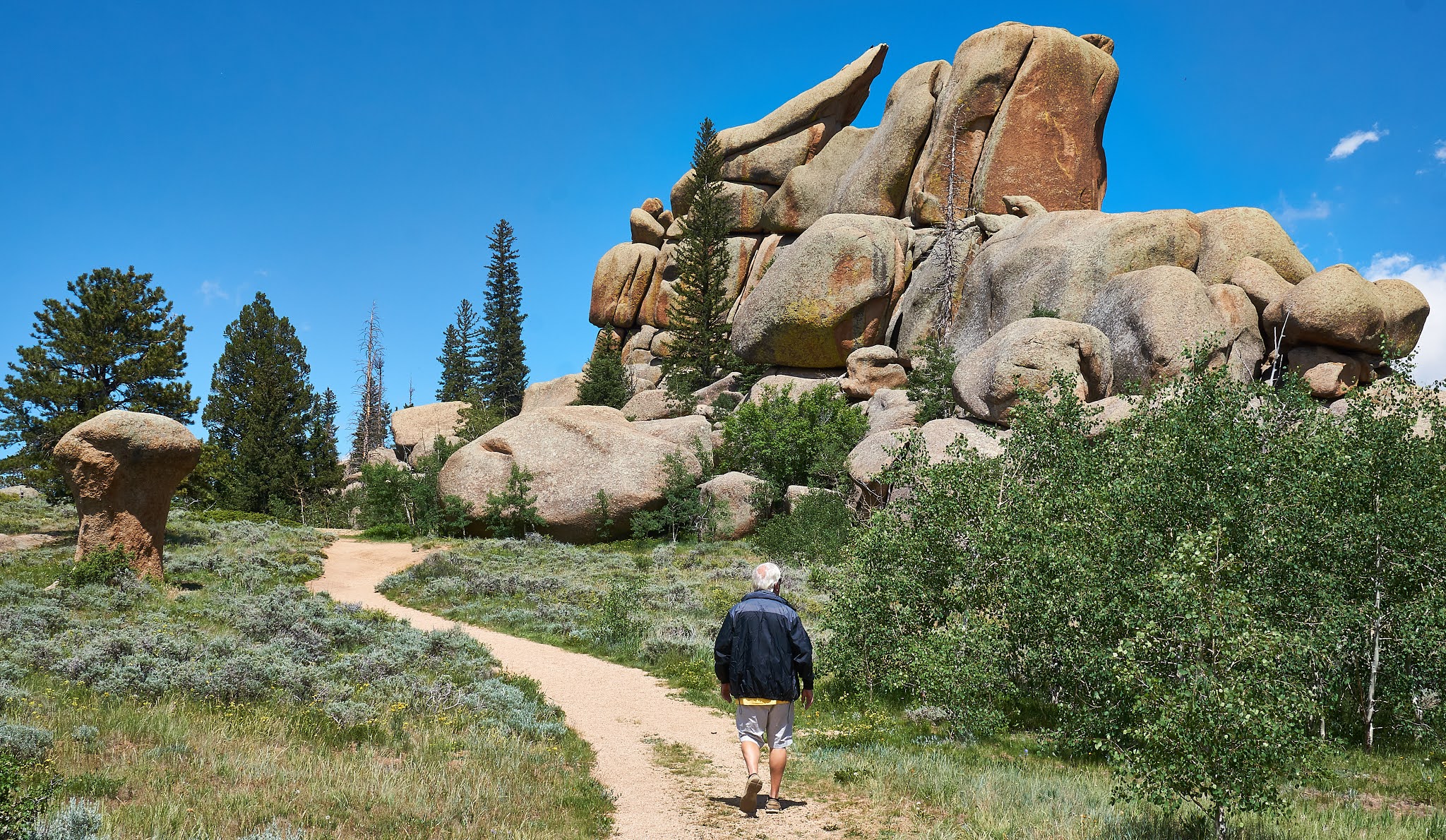
Our last stop just off West Interstate 80 was the Vedauwoo Recreation Area.  These enormous Sherman granite rocks have eroded into forms that look like hoodoos and marshmallows.  Native Americans gave these unusual land-forms this name, meaning "Land of the Earthborn Spirits".  Now it is a rock climbers' paradise with several different sections of climbing difficulty.  Ronnie and I enjoyed a walk around one of the formations, finding all kinds of sheltering places Native Americans could have used. 

 
  My imagination saw huge boulders perfectly placed to look like stacked, toasted marshmallows.


Vedauwoo also has it's own tree growing from a rock.


The prairie rose bushes were in bloom as well.


Vedauwoo has several huge rock clusters with their own distinct formations.  This grouping has a boulder perched like a dice on its point. 


And many of the boulders are huge!


These are the Sherman Mountains, what is left of them after millions of years of erosion by wind, water and ice. It is this weathering that has rounded the corners resulting in the blocky like rock forms.


In spite of what appears to be a dry, arid environment, this stream flows through the Vedauwoo Recreation Area.


Coming up on the 'Turtle Rock Trail', we were able to catch the ending segmant of a rock climber's experience for the day.


Using binoculars, we were able to see the climber on the rock's surface crack.  You'll see him between the tree and boulder, just to the top, left of center on the crack near the top of the rock .


By the time I put my telephoto lens on the camera, the rock climber had reached the very top, finishing his climb. 


Windshield Update: A new windshield is finally on its way from Elkhart, Indiana to the installer in Rawlins, Wyoming.  We're staying in Laramie until we have conformation the winsdhield arrived without damage and we have a scheduled appintment.

More Later from Laramie.